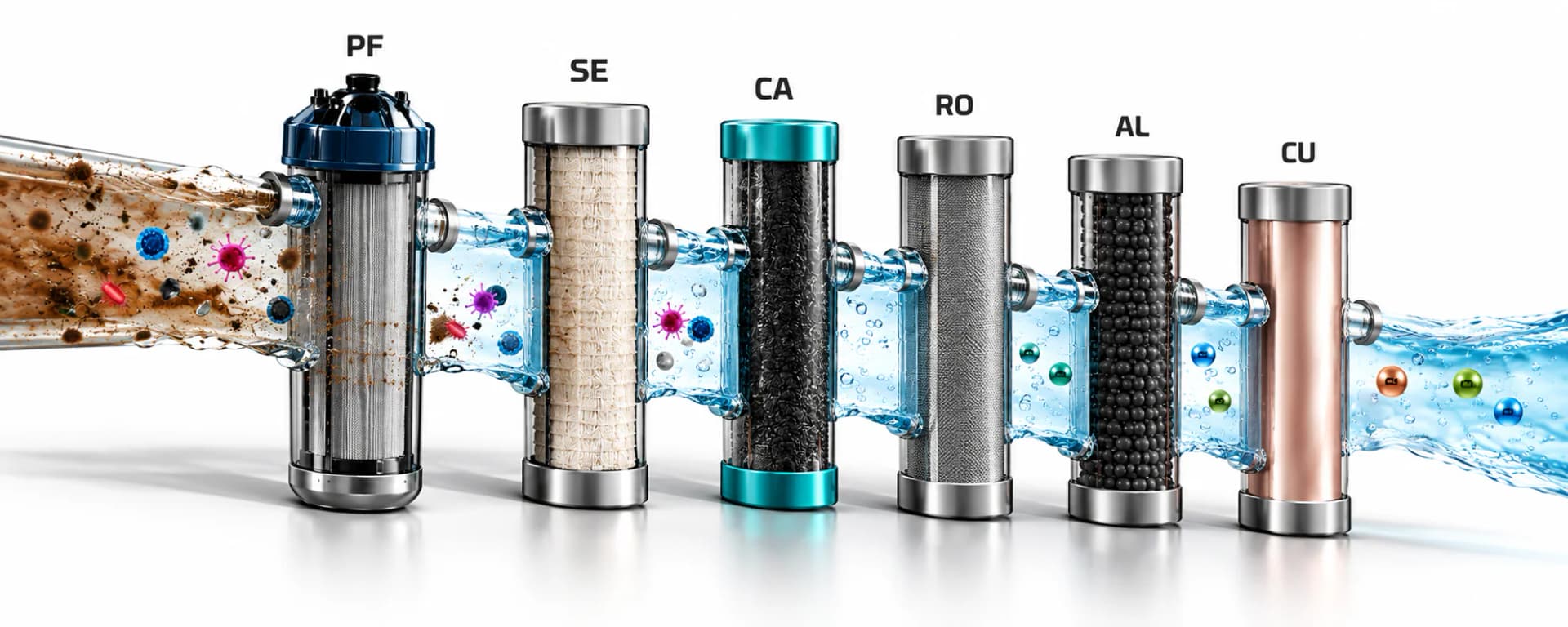
Every water purifier, from a ceramic candle to a commercial RO plant, relies on a small set of physical and chemical principles. Understanding them makes it much easier to see through marketing language and choose a system that matches the water you actually have.
What is water purification?
Water purification is any process that removes, reduces or inactivates contaminants so water is safe and acceptable to drink. “Safe” is defined by standards: in India, IS 10500:2012 sets acceptable and permissible limits for physical, chemical and microbiological parameters.[1]
Professionals usually separate treatment (making water meet a standard) from conditioning (changing a property such as scaling tendency without removing contaminants). A water softener or a scale conditioner is not a drinking-water purifier, even though all three are often sold together.
- Contaminant
- Any physical, chemical, biological or radiological substance in water. Some (such as calcium) are harmless or beneficial at normal levels; others (such as arsenic or E. coli) are harmful even at low levels.
- Pathogen
- A disease-causing microorganism: bacteria, viruses or protozoan cysts.
- TDS
- Total dissolved solids, the combined mass of dissolved salts and minerals, in mg/L (≈ ppm). See our TDS guide.
- Log reduction
- A measure of microbial removal. 1-log = 90%, 2-log = 99%, 4-log = 99.99%.
What does purification need to remove?
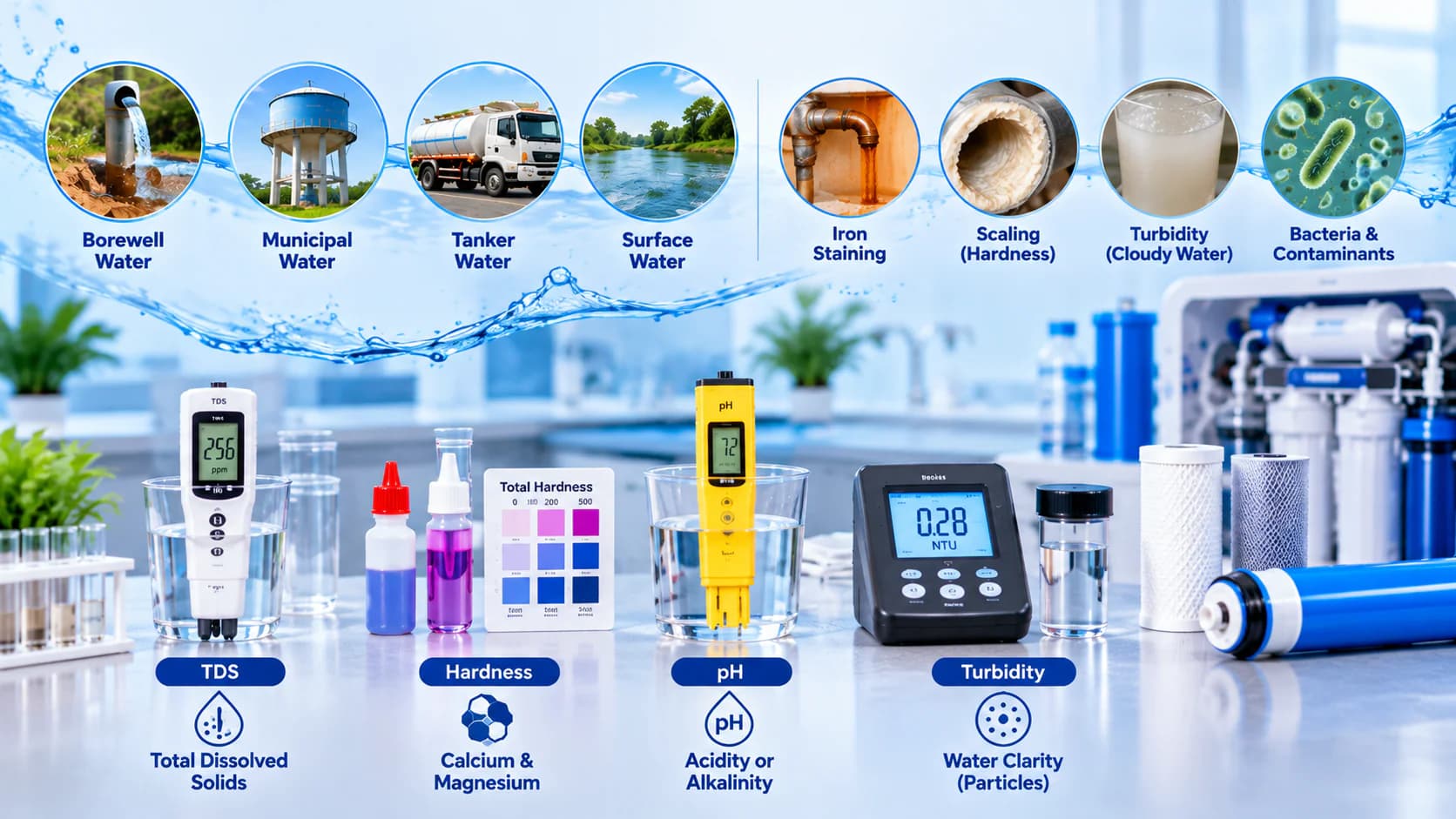
Contaminants fall into three groups, and each group needs a different kind of treatment. A method that is excellent for one group can do almost nothing for another.
| Group | Examples | Typical treatment |
|---|---|---|
| Suspended particles | Sand, silt, rust flakes, turbidity | Sediment filters, sand filters (straining) |
| Dissolved chemicals | Salts (TDS), fluoride, nitrate, arsenic, iron, chlorine, pesticides | Activated carbon (organics, chlorine); RO (dissolved salts and many ions); specialised media (iron, arsenic) |
| Microorganisms | Bacteria, viruses, protozoan cysts | UV, UF/RO membranes, chlorination, boiling |
How does water purification work?
Purification works by combining four mechanisms. Particles are physically strained out, organic chemicals stick to adsorbent surfaces, membranes separate water from dissolved substances, and disinfection inactivates the microorganisms that remain.
1. Physical straining (sediment filtration)
A porous medium blocks particles larger than its pores. Spun polypropylene cartridges rated at around 5 microns are common as the first stage in home purifiers. Straining reduces turbidity and protects later stages from clogging, but it does nothing for dissolved chemicals and does not reliably stop bacteria (about 0.5–5 µm) or viruses (about 0.02–0.3 µm).[3]
2. Adsorption (activated carbon)
Activated carbon has a very large internal surface area, and organic molecules stick to it. It is effective for chlorine, taste, odour and many organic chemicals. It does not lower TDS, hardness, fluoride or nitrate. Read the full explanation in Activated Carbon Filtration.[3][4]
3. Membrane separation (UF and RO)
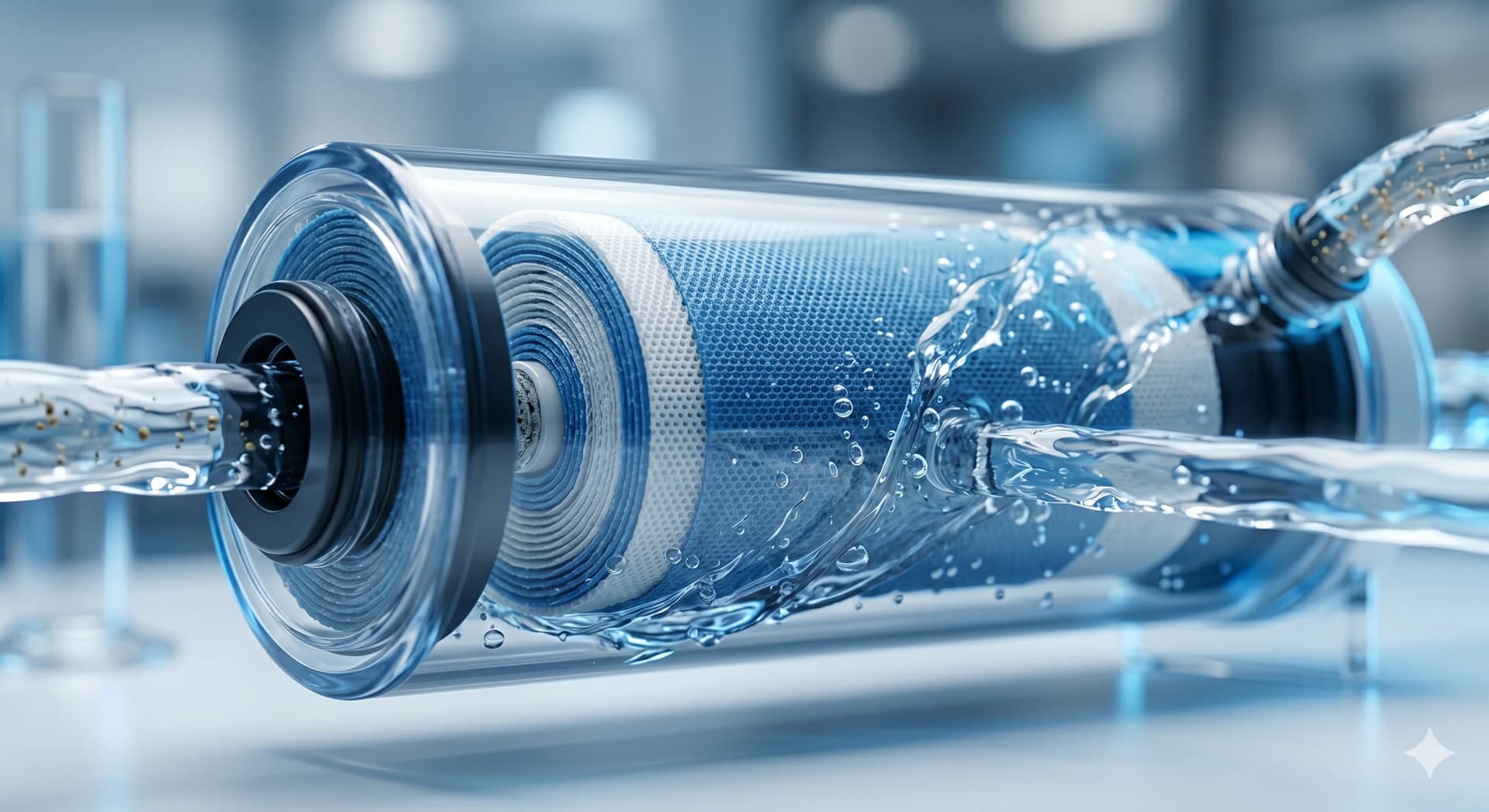
Ultrafiltration (UF) membranes have pores of roughly 0.01–0.1 µm. They remove bacteria and cysts but let dissolved salts pass. Reverse osmosis (RO) uses pressure to push water through a dense membrane that rejects most dissolved ions, typically more than 90% of TDS, along with many heavy metals, fluoride and nitrate. See Membrane Filtration.[3][5]
4. Disinfection (UV, chlorine, boiling)
Disinfection inactivates pathogens rather than removing them. UV-C light at around 254 nm damages microbial DNA and RNA so organisms cannot reproduce. Chlorine is used by municipalities because it leaves a protective residual in the pipes, and boiling works anywhere. None of these methods removes dissolved chemicals. See UV Water Disinfection.[2][6]
| Mechanism | Good at | Does not address |
|---|---|---|
| Straining (sediment) | Sand, silt, rust, turbidity | Dissolved chemicals, most microbes |
| Adsorption (carbon) | Chlorine, taste, odour, many organics | TDS, hardness, fluoride, nitrate, microbes |
| UF membrane | Bacteria, cysts, colloids | Dissolved salts, TDS |
| RO membrane | TDS, many ions and heavy metals, microbes | Some dissolved gases; needs pre-filtration; produces reject water |
| UV disinfection | Bacteria, viruses, cysts (when water is clear) | Chemicals, TDS; no residual protection in storage |
Why do purifiers use multiple stages?
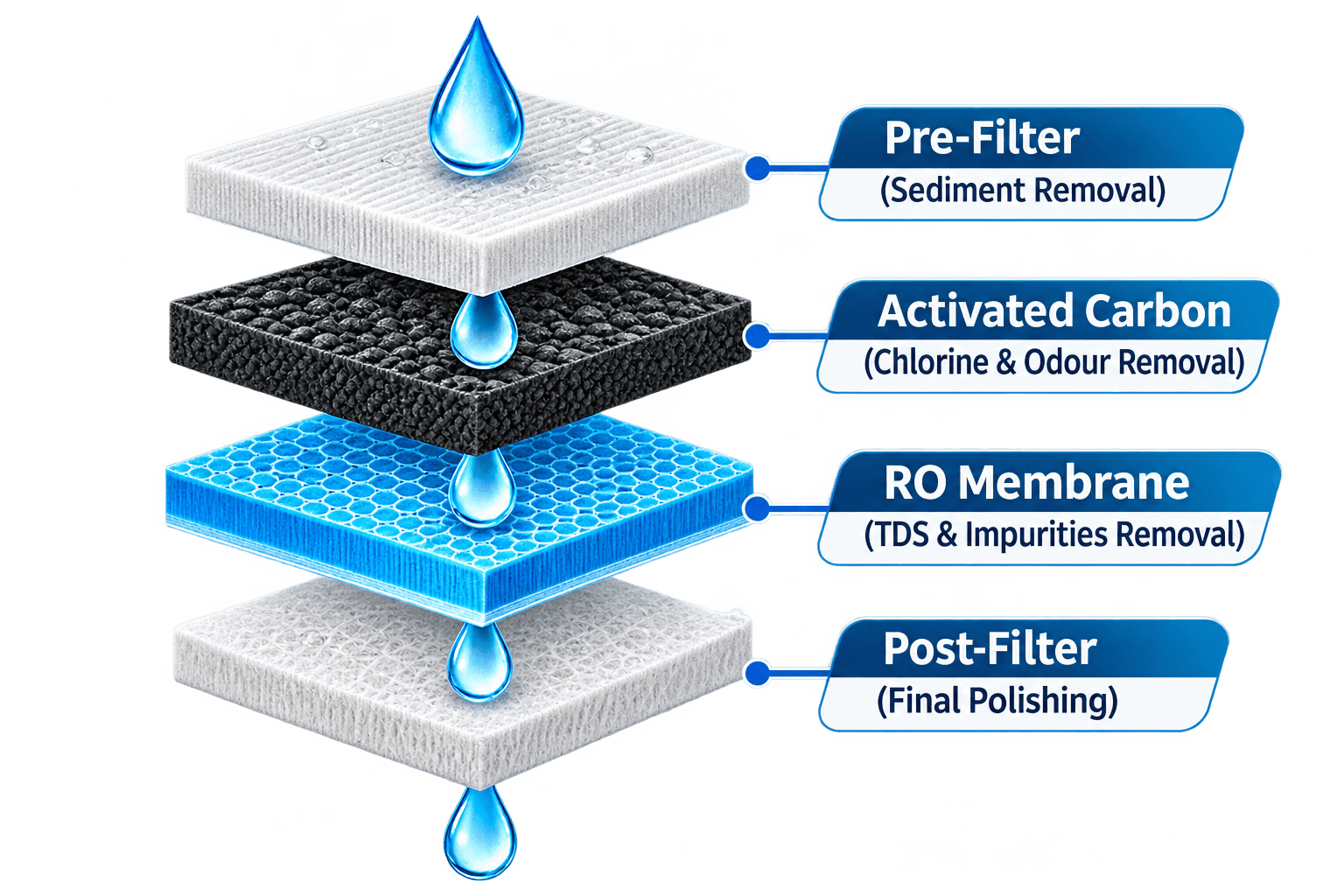
Because no single mechanism covers all three contaminant groups. Stages are ordered so that each one protects the next: sediment protects carbon, carbon removes chlorine that would damage an RO membrane, and UV is placed last to disinfect clear, purified water.
This is the multi-barrier principle that WHO recommends for drinking-water safety in general: several independent barriers are more reliable than any one perfect barrier. We explain a typical stage order in Stages of Water Purification Explained.[2]
A practical example: borewell water in Hyderabad
Suppose a borewell sample reads 900 mg/L TDS with high hardness and occasional turbidity. A UV-only purifier would disinfect it but leave the TDS untouched, well above the IS 10500 acceptable limit of 500 mg/L. A sensible chain is sediment, then carbon, then RO (to reduce TDS), then UV or UF as a final microbial barrier, with optional remineralisation for taste. If the same home were on treated municipal supply at 150 mg/L TDS, RO might be unnecessary, and carbon plus UV/UF would usually be enough.[1]
What are the limitations of home water purification?
What a well-chosen purifier does
- Provides a final barrier at the point of use, after pipes and storage tanks
- Can reduce contaminants that municipal treatment does not target (for example, high TDS in borewell water)
- Improves taste and odour
What to keep in mind
- Performance depends on maintenance: exhausted cartridges and old UV lamps stop working
- RO produces reject water, so look for systems with higher recovery
- Over-treating low-TDS water adds cost and waste without a benefit
- Claims should be backed by recognised standards or test reports