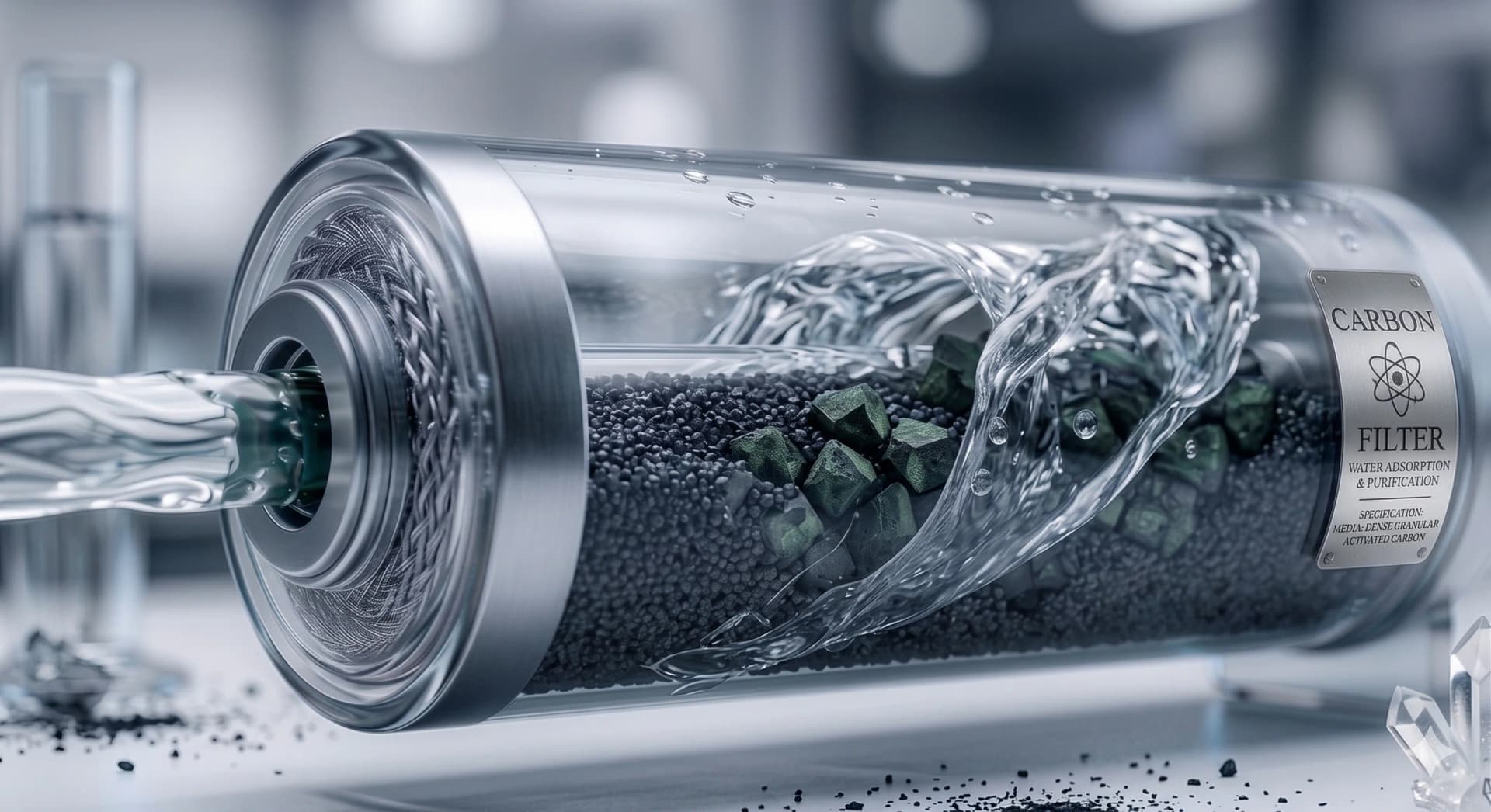
Almost every water purifier contains at least one carbon stage, and many contain two. Carbon is one of the most versatile tools in water treatment, but its limits are often misunderstood.
What is activated carbon?
Activated carbon is carbon from coconut shell, coal or wood that has been processed (activated) with steam or chemicals at high temperature to create a dense network of tiny pores. This gives it a very large internal surface area, typically about 500–1,500 m² per gram.[1][2]
- Adsorption
- Molecules adhering to a surface. It is different from absorption, where a substance is taken into a material's bulk.
- GAC
- Granular activated carbon: loose granules in a cartridge or vessel.
- Carbon block
- Powdered carbon bonded into a solid porous block. It has finer pores, more contact and also strains fine particles.
- Empty bed contact time (EBCT)
- How long water is in contact with the carbon. Longer contact means better removal.
How does activated carbon filtration work?
As water flows through the carbon, organic molecules are attracted to and held on the pore surfaces by weak physical forces (van der Waals forces). Chlorine is handled differently: carbon catalytically reduces free chlorine to chloride, which is why chlorine removal is fast and very effective.[1]
Larger, less water-soluble organic molecules (many pesticides, solvents and taste and odour compounds) adsorb strongly. Small, highly soluble or charged species (sodium, calcium, nitrate, fluoride) barely adsorb at all. That is why carbon improves taste dramatically but leaves TDS almost unchanged.[1][2]
What does a carbon filter remove and not remove?
| Reduces well | Reduces partially / depends on design | Does not remove |
|---|---|---|
| Free chlorine | Chloramine (needs catalytic carbon and long contact) | TDS / dissolved salts |
| Taste and odour compounds | Some pesticides and solvents (VOCs) | Hardness (calcium, magnesium) |
| Many organic chemicals | Lead (only specially formulated blocks) | Fluoride, nitrate, arsenic |
| Colour from organics | Fine particles (carbon block) | Bacteria and viruses (not reliably) |
Carbon block vs granular activated carbon (GAC)
| Carbon block | GAC | |
|---|---|---|
| Structure | Compressed, bonded fine carbon | Loose granules |
| Contact & channelling | Uniform contact, no channelling | Water can channel around granules |
| Particle filtration | Also filters fine particles | Minimal |
| Flow / pressure drop | Higher pressure drop | Lower pressure drop |
| Typical use | Pre-RO, point-of-use | Post-carbon polishing, large vessels |
Where is carbon used in a purifier?
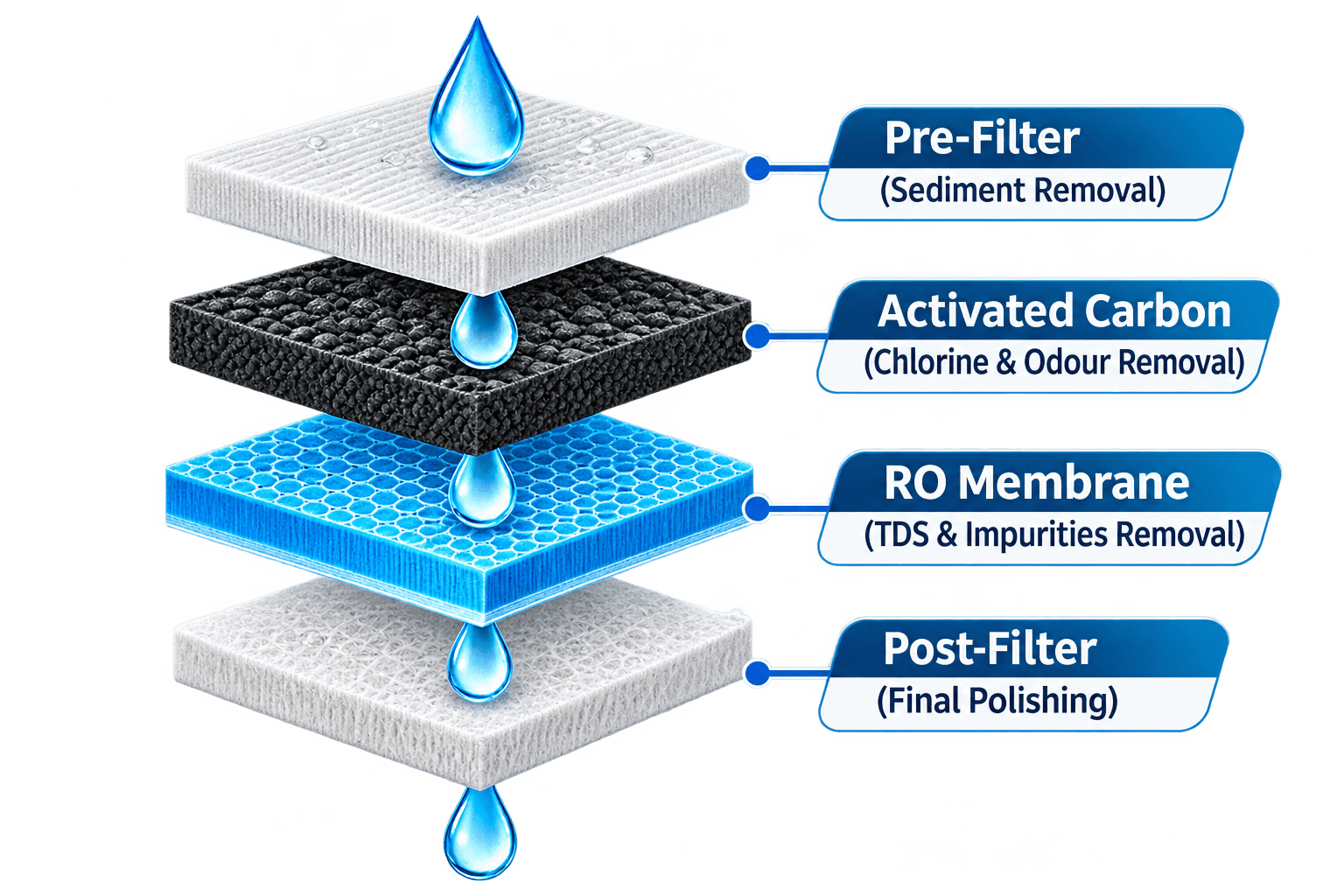
Usually twice: a pre-carbon stage before the RO membrane, to remove chlorine that would damage it, and a post-carbon (polishing) stage after storage, to remove any taste or odour picked up in the tank. See Stages of Water Purification Explained.
In whole-home and commercial systems, large carbon vessels treat chlorinated municipal water or remove odour from borewell water before it reaches taps and appliances.
What are the limitations of activated carbon?
Strengths
- Highly effective for chlorine, taste and odour
- Removes a wide range of organic chemicals
- No electricity or chemicals; no waste water
- Protects RO membranes
Limitations[1]
- Finite capacity: once saturated, removal stops and can even reverse
- Can support bacterial growth, especially after chlorine is removed
- No effect on TDS, hardness, fluoride or nitrate
- Performance falls at high flow (short contact time)