Purifier brochures often lead with a number: 6-stage, 8-stage, 10-stage. The number on its own tells you very little. What matters is which mechanisms are present, the order they are in, and whether they are maintained. This guide walks through a typical RO + UV chain from tap to glass.
What are the stages of water purification?
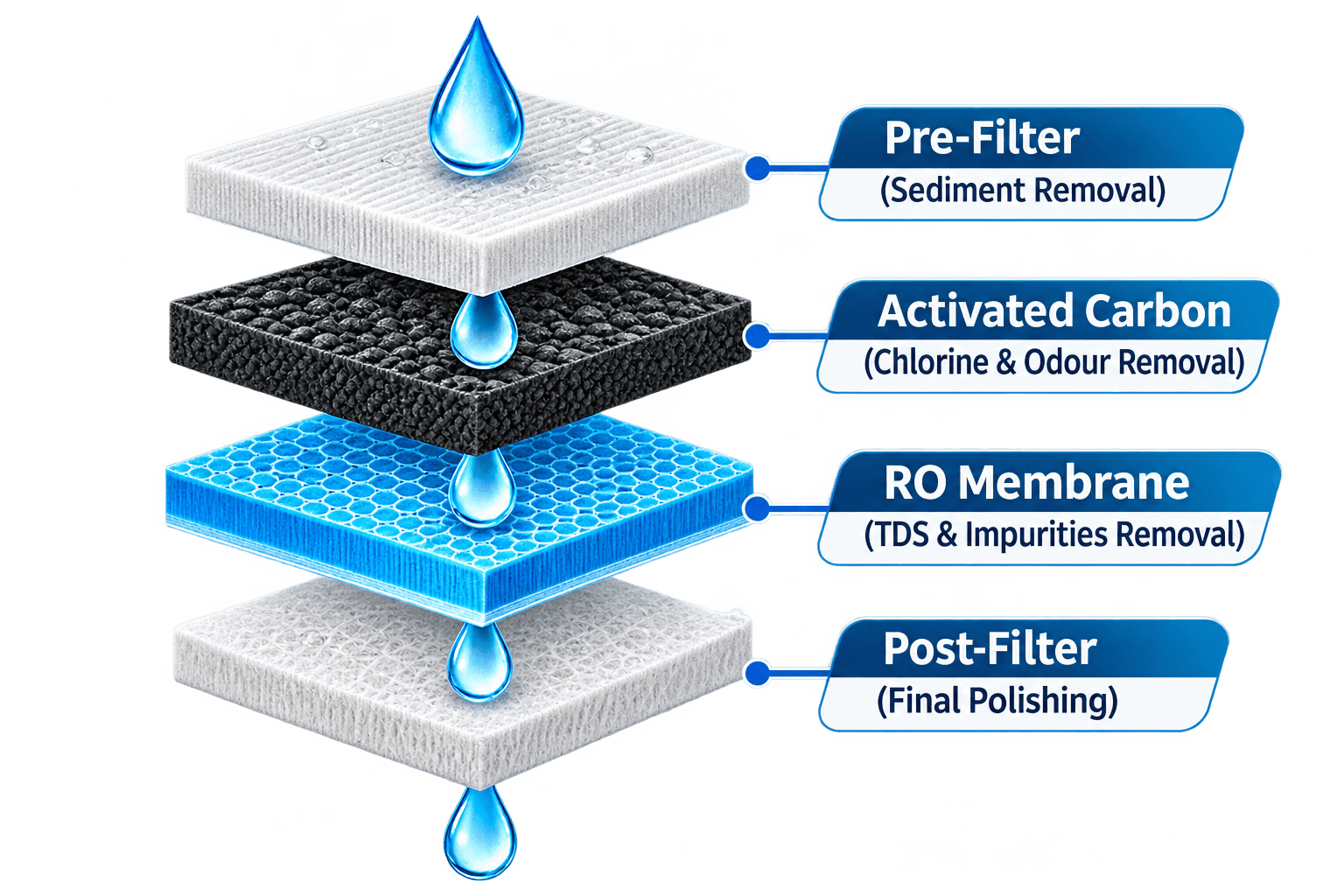
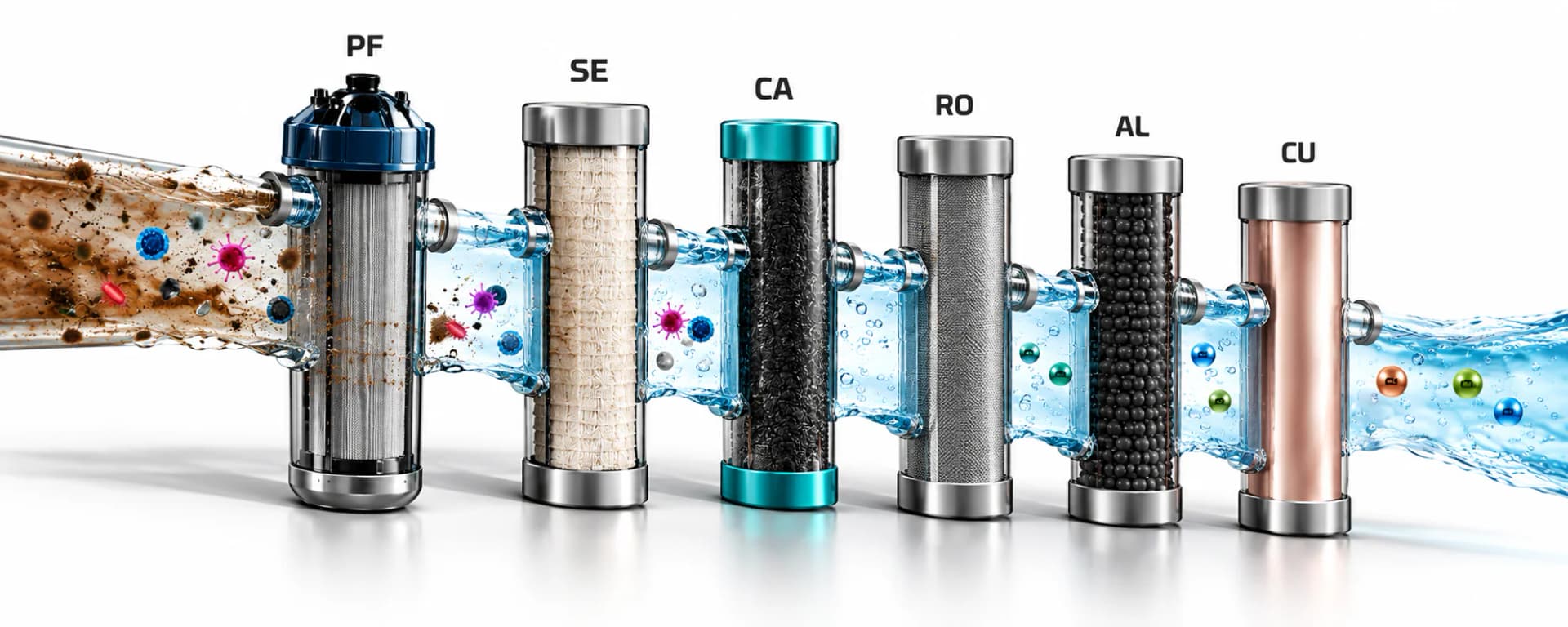
In a domestic RO + UV purifier, the usual sequence is: (1) sediment filter, (2) activated carbon, (3) RO membrane, (4) UV and/or UF, and (5) post-treatment (polishing carbon, mineral or alkaline cartridge). Municipal treatment follows a similar logic at a larger scale: coagulation, sedimentation, sand filtration and chlorination.[1][2]
| Stage | Mechanism | Main job | Does not do |
|---|---|---|---|
| 1. Sediment (about 5 µm) | Straining | Removes sand, silt and rust; protects later stages | Remove dissolved chemicals or microbes |
| 2. Activated carbon | Adsorption | Removes chlorine, odour and organic chemicals; protects the RO membrane | Lower TDS, hardness or fluoride |
| 3. RO membrane | Pressure-driven membrane separation | Reduces TDS and many dissolved ions, including heavy metals, fluoride and nitrate | Work without pre-filtration and pressure |
| 4. UV lamp / UF membrane | Disinfection / ultrafiltration | Inactivates (UV) or removes (UF) bacteria, viruses and cysts | Change TDS |
| 5. Post-treatment | Polishing carbon, mineral dosing | Improves taste; may add calcium/magnesium and raise pH | Purify water on its own |
Stage 1: Why is the sediment filter first?
Because particles clog and scratch everything downstream. A sediment cartridge, often spun polypropylene rated around 5 microns, catches sand, silt and rust so that the carbon and membrane last longer.
On borewell water with high turbidity or iron, a single cartridge may block within weeks. In that case a whole-house sand or iron filter ahead of the purifier is often more economical than replacing cartridges frequently.
Stage 2: What does the carbon stage do?
Activated carbon adsorbs chlorine, chloramine-related taste, odours and many organic chemicals. In an RO system it has a second job: removing chlorine, which chemically damages thin-film composite RO membranes.[1]
Stage 3: What does the RO membrane remove?
The RO membrane rejects most dissolved salts. TDS reductions above 90% are typical, along with many heavy metals, fluoride, nitrate and microorganisms. It is the stage that makes high-TDS borewell water drinkable.[1][3]
RO also produces a concentrate (reject) stream. How much water a system wastes depends on its recovery rate, so this is worth comparing. In 2019 the National Green Tribunal directed the Government to regulate RO use and require better recovery, particularly where supply TDS is already low. More detail is in Membrane Filtration.[6]
Stage 4: Why add UV or UF after RO?
As an independent microbial barrier. RO membranes reject microbes, but seals and O-rings can leak, and bacteria can regrow in the storage tank. A UV lamp or UF membrane after RO or after the tank adds a second, separate line of defence.
UV works best on clear water, which is one reason it is placed after the other stages. Its effectiveness depends on delivering enough UV dose, which falls as the lamp ages or the quartz sleeve fouls. See UV Water Disinfection.[4][5]
Stage 5: What do mineral, copper and alkaline stages do?
Post-treatment cartridges change the taste and chemistry of purified water. Mineral or alkaline cartridges dissolve small amounts of calcium and magnesium, which raises pH and TDS slightly. Copper and zinc stages release trace amounts of those metals.
These stages are about taste and water chemistry. They do not make up for a weak purification chain. For a full explanation of how remineralisation works and what it can and cannot do, read Mineralization Technology.[7]
Is a purifier with more stages better?
Not necessarily. Two stages that do the same job (for example, two carbon cartridges) do not double performance. A shorter chain that matches your water and is maintained on schedule will outperform a longer one with expired filters.
- Ask what each stage removes, not just how many stages there are.
- Check whether RO is needed for your TDS level, or whether UV/UF plus carbon is enough.
- Ask for replacement intervals and costs for every cartridge, membrane and UV lamp.
- Look for certification to a recognised standard (for example BIS IS 16240 for RO systems) and the test basis behind any “99.99%” claim.[3]