
Most purifier buying guides rank models. This one does not. The right system for a flat on treated municipal supply in Hyderabad is different from the right system for a farmhouse on a 600-foot borewell, and both are different from what a 40-person office needs. Work through the steps below in order.
Step 1: What is your water source?
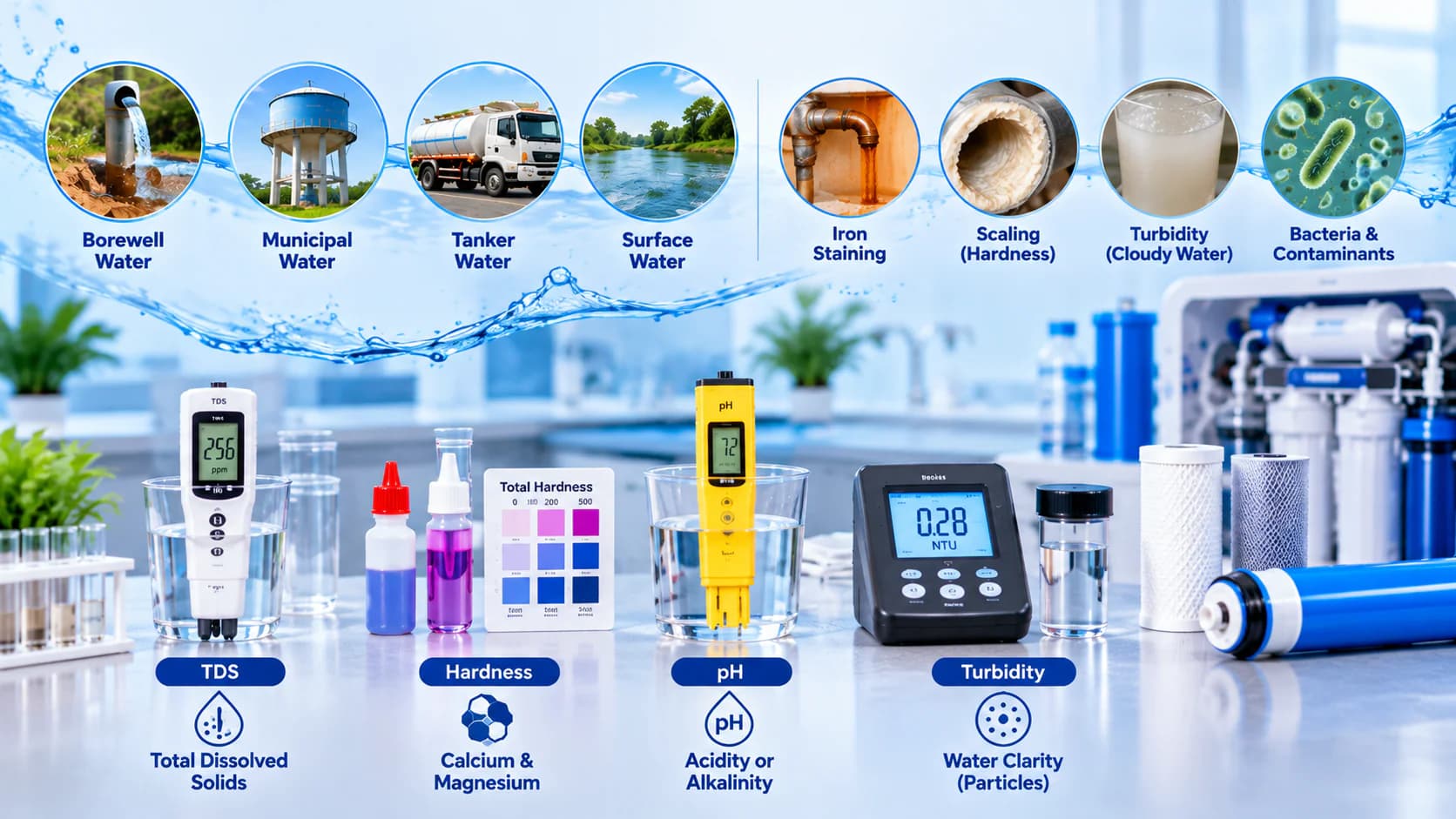
Your source predicts your likely problems. Municipal water is usually disinfected but can be recontaminated in pipes and tanks. Borewell water more often carries high TDS, hardness, iron or fluoride. Tanker water quality varies from load to load.[1]
| Source | Common issues | What to test |
|---|---|---|
| Municipal (treated) | Microbes from pipes or tanks, chlorine taste, occasional turbidity | TDS, bacteria, residual chlorine |
| Borewell / groundwater | High TDS, hardness, iron, fluoride, nitrate (region-dependent) | TDS, hardness, iron, fluoride, nitrate, bacteria |
| Tanker | Highly variable; microbes and TDS | TDS and bacteria, repeated over several loads |
| Mixed sources | Changes with the season | Test each source separately |
Step 2: How do I test my water?
Measure TDS with a handheld meter for a first reading. Then get a laboratory test for hardness, iron, fluoride, nitrate and coliform bacteria, ideally at an NABL-accredited lab or through your local public health engineering laboratory.[3][4]
A TDS meter estimates dissolved salts from electrical conductivity. It cannot detect bacteria, pesticides or most heavy metals at harmful levels. Our Water Quality Testing guide explains which tests matter and how to read the results.
Step 3: Which technology does your water need?
Match each finding to a mechanism: dissolved salts and ions need RO; microbes need UV and/or UF; chlorine, taste and organics need carbon; heavy sediment or iron need pre-treatment. Add only what your test justifies.
From test result to technology[2]
| Test finding | Relevant IS 10500 limit | Technology to consider |
|---|---|---|
| TDS above 500 mg/L | 500 mg/L acceptable (2,000 mg/L permissible in absence of an alternate source) | RO |
| Fluoride above 1.0 mg/L | 1.0 acceptable, 1.5 mg/L permissible | RO (or specialised defluoridation media) |
| Nitrate above 45 mg/L | 45 mg/L, no relaxation | RO |
| Coliform / E. coli detected | Must not be detectable in any 100 mL sample | UV and/or UF (plus fixing the source) |
| Hardness above 200 mg/L as CaCO₃ | 200 acceptable, 600 mg/L permissible | RO for drinking; softener or conditioner for whole-home scale |
| Iron staining / turbidity | Turbidity 1 NTU acceptable, 5 permissible | Sediment or iron-removal pre-filter |
| Chlorine taste or odour | Residual free chlorine minimum 0.2 mg/L at the tap | Activated carbon |
Step 4: What capacity do you need?
Estimate drinking plus cooking use. A common planning figure is about 2–3 litres per person per day for drinking, plus cooking. Then choose storage that covers your peak use and any power cuts, since RO and UV need electricity.
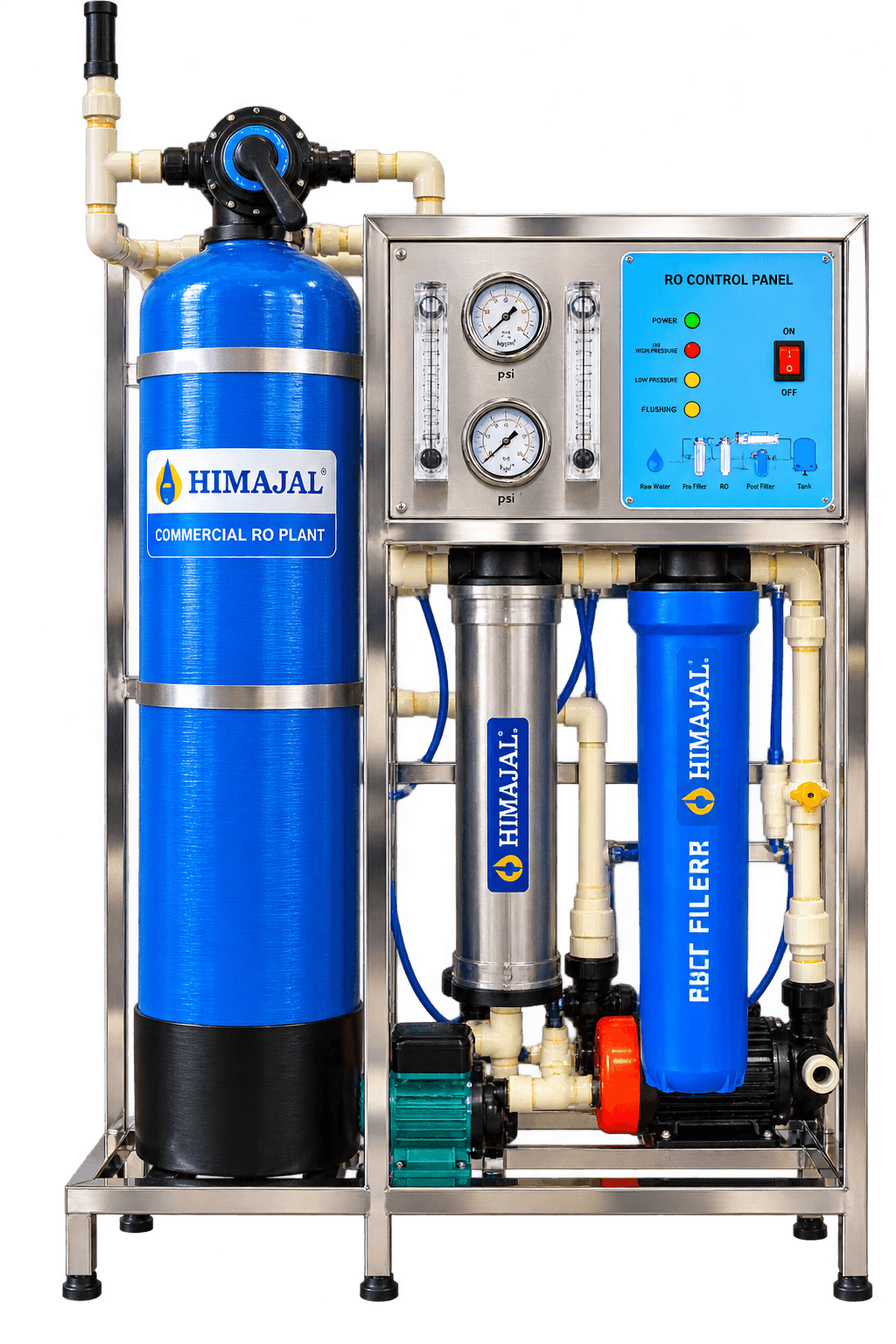
For offices, schools and clinics, size for the number of people per shift and peak hours. Above a few hundred litres a day, a commercial RO plant is usually more economical than several domestic units.
Step 5: How do I compare running cost and service?
Add up five years of cartridges, membranes, UV lamps, service visits and electricity, plus the cost of reject water for RO. Then confirm that the brand has trained technicians and genuine spares near you.
- Recovery rate (RO): how much of the inlet water becomes drinking water. Higher recovery means less waste.
- Certification: look for a recognised standard (for example BIS IS 16240 for RO systems) and ask for the test report behind performance claims.
- Replacement schedule: intervals and prices for each consumable.
- Service network: response time, AMC options, and availability of genuine parts.
- Material safety: food-grade tanks and components.[6]
What claims should make you cautious?
- Disease-cure or medical claims for drinking water (for example, that it cures acidity, diabetes or cancer).
- “99.99% removal” without saying of what, under which test standard, and by which lab.
- A TDS meter demonstration used as proof of safety.
- Electrolysis demonstrations that make tap water change colour. These show dissolved iron and electrode corrosion, not contamination levels.[7][8]