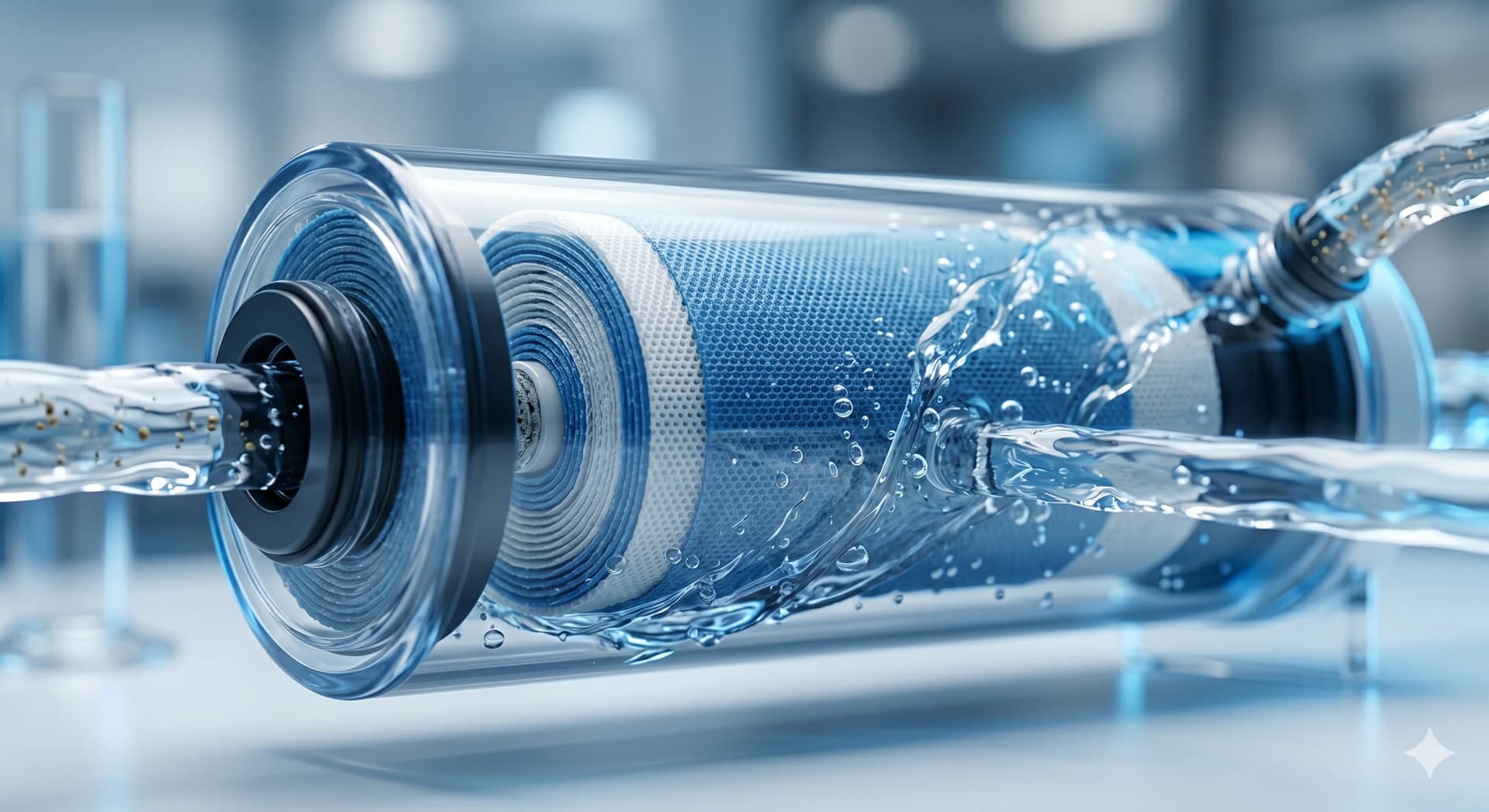
Membranes are the workhorses of modern water treatment, from village UF units to seawater desalination plants. Understanding the membrane spectrum explains why an RO purifier removes TDS and a UF purifier does not.
What is membrane filtration?
Membrane filtration is a pressure-driven separation in which water passes through a thin polymeric or ceramic barrier while contaminants are held back. The water that passes is the permeate; the stream carrying rejected contaminants is the concentrate (reject).[1][2]
What are the types of membrane filtration?
| Type | Approx. pore / cut-off | Removes | Passes | Typical pressure |
|---|---|---|---|---|
| Microfiltration (MF) | 0.1–10 µm | Suspended solids, protozoan cysts, most bacteria | Viruses, dissolved salts | Low |
| Ultrafiltration (UF) | 0.01–0.1 µm | Bacteria, cysts, colloids; viruses depending on rating | Dissolved salts | Low (can be gravity or mains) |
| Nanofiltration (NF) | About 0.001 µm | Hardness (divalent ions), organics, some salts | Part of monovalent salts (e.g. sodium chloride) | Medium |
| Reverse osmosis (RO) | Dense, non-porous selective layer | Most dissolved salts, many metals, fluoride, nitrate, microbes | Water, some dissolved gases (CO₂) | High (pump) |
How does reverse osmosis work?
In natural osmosis, water moves through a membrane from the dilute side to the concentrated side. RO applies pressure greater than the osmotic pressure to reverse that flow, pushing water out of the salty feed and leaving most dissolved ions behind in the concentrate.[1]
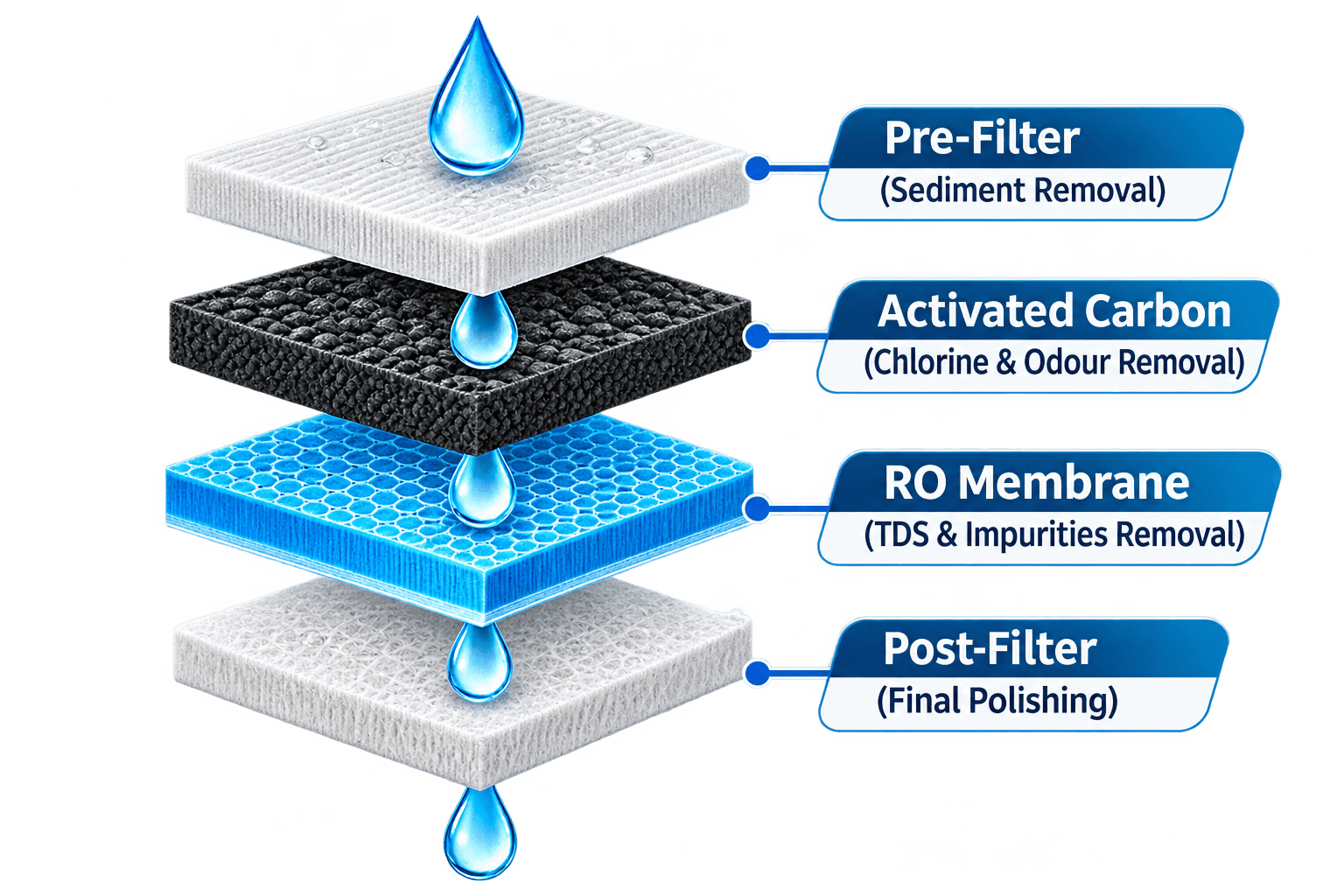
Domestic RO uses thin-film composite (TFC) membranes wound in a spiral. A booster pump raises pressure, and a flow restrictor on the reject line maintains it. Rejection depends on the ion: divalent ions such as calcium and sulphate are rejected more strongly than monovalent ions such as sodium and nitrate.[1][3]
Why does RO waste water, and how can it be reduced?
RO needs a continuous concentrate flow to carry rejected salts away from the membrane. Otherwise salts would precipitate (scale) and foul it. The share of feed water that becomes drinking water is the recovery rate; the rest goes to drain.
- Choose purifiers designed for higher recovery.
- Use RO only where source TDS or contaminants actually require it.
- Reuse reject water for mopping, gardening (if TDS is moderate) or flushing.
- Pre-treat hard or iron-rich water so the membrane can run at higher recovery without scaling.[4]
India's National Green Tribunal in 2019 directed the government to regulate RO purifiers, discouraging their use where TDS is below 500 mg/L and requiring better water recovery.[4]
What damages a membrane?
| Problem | Cause | Prevention |
|---|---|---|
| Scaling | Calcium carbonate and sulphate precipitating in the concentrate | Antiscalant, softening or conditioning, lower recovery on hard water |
| Particulate fouling | Silt and turbidity | Sediment pre-filter |
| Chemical damage | Free chlorine attacks TFC membranes | Carbon pre-filter |
| Biofouling | Bacterial slime on the membrane | Regular use, sanitisation, timely filter changes |
| Iron/manganese fouling | Oxidised metals depositing | Iron-removal pre-treatment |
Should you choose UF or RO?
Choose UF when TDS is already acceptable and you need a microbial barrier without electricity. Choose RO when TDS or dissolved contaminants (fluoride, nitrate, arsenic) exceed IS 10500 limits. Many purifiers use both: RO for chemistry and UF as an extra barrier. See RO vs UV vs UF.[5]