RO, UV and UF are not competing versions of the same thing. They solve different problems. Treating them as interchangeable is the most common reason people end up with the wrong purifier, either over-treating good municipal water or under-treating salty borewell water.
What is the difference between RO, UV and UF?
RO is a separation process for dissolved substances, UV is a disinfection process for microbes, and UF is a fine physical filter for microbes and particles. Only RO changes TDS.
| RO (Reverse Osmosis) | UV (Ultraviolet) | UF (Ultrafiltration) | |
|---|---|---|---|
| How it works | Pressure pushes water through a dense semi-permeable membrane | UV-C light (about 254 nm) damages microbial DNA/RNA | Hollow-fibre membrane with pores of about 0.01–0.1 µm |
| Reduces TDS / dissolved salts | Yes (typically more than 90%) | No | No |
| Fluoride, nitrate, arsenic, heavy metals | Substantially reduced | No | No (except metals bound to particles) |
| Bacteria & cysts | Rejected by membrane | Inactivated | Physically removed |
| Viruses | Rejected by intact membrane | Inactivated | Depends on membrane rating |
| Chemicals, pesticides, chlorine | Many reduced (with carbon pre-filter) | No | No |
| Electricity needed | Yes (booster pump) | Yes (lamp) | No |
| Reject / waste water | Yes; depends on recovery rate | None | None or minimal (flushing) |
| Removes dead microbes from water | Yes | No (they stay in the water, inactivated) | Yes |
| Typical consumables | Pre-filters, membrane | Lamp (about yearly), sleeve cleaning | Membrane, pre-filter |
What does an RO purifier do?
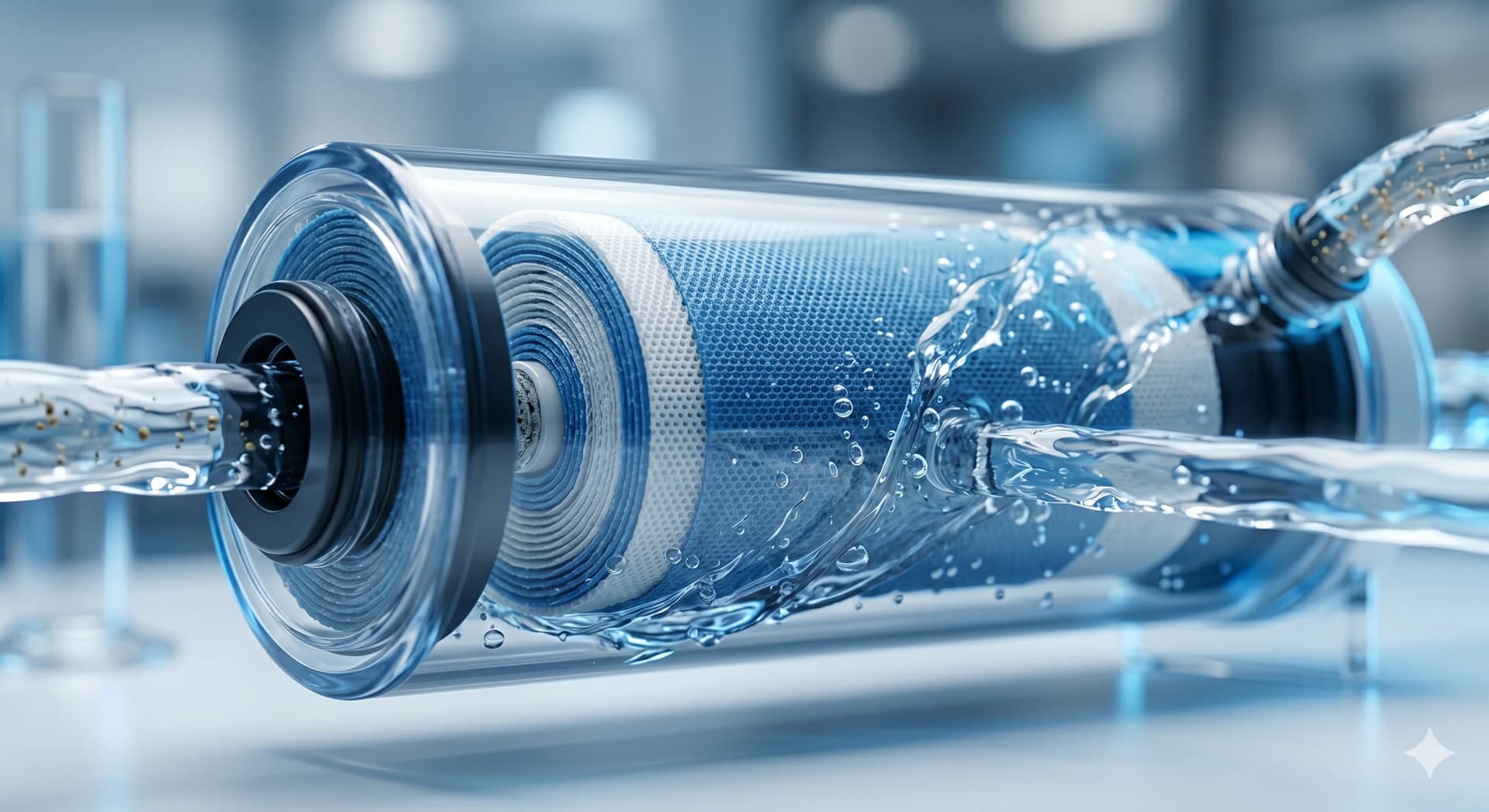
An RO purifier uses a pump to force water through a membrane that lets water molecules pass but rejects most dissolved ions. It is the right tool when TDS is above the IS 10500 acceptable limit of 500 mg/L, or when specific dissolved contaminants (fluoride, nitrate, arsenic) are present.[1][5]
Trade-offs: RO produces reject water, removes beneficial minerals along with harmful ones, and adds a pump and membrane to maintain. On low-TDS municipal water these costs often bring no safety benefit, which is why the National Green Tribunal directed regulation of RO use where supply TDS is below 500 mg/L.[6][7]
What does a UV purifier do?
A UV purifier exposes flowing water to germicidal ultraviolet light. Bacteria, viruses and protozoa absorb the energy, their genetic material is damaged, and they can no longer multiply. Nothing is removed or added to the water.[2][4]
UV is effective only when the water is clear: turbidity and particles can shield microbes. It provides no residual protection, so water stored after UV can be recontaminated. It needs continuous power, and the lamp's output declines with age.
What does a UF purifier do?
A UF purifier passes water through hollow-fibre membranes with pores of roughly 0.01–0.1 microns. Bacteria, protozoan cysts and fine particles are physically held back. Dissolved salts, fluoride and other ions pass straight through.[1]
Because UF works on mains or gravity pressure without electricity, it is useful as a backup barrier and in areas with unreliable power. Not every UF membrane is rated for virus removal, so check the specification.
Which purifier is right for my water?
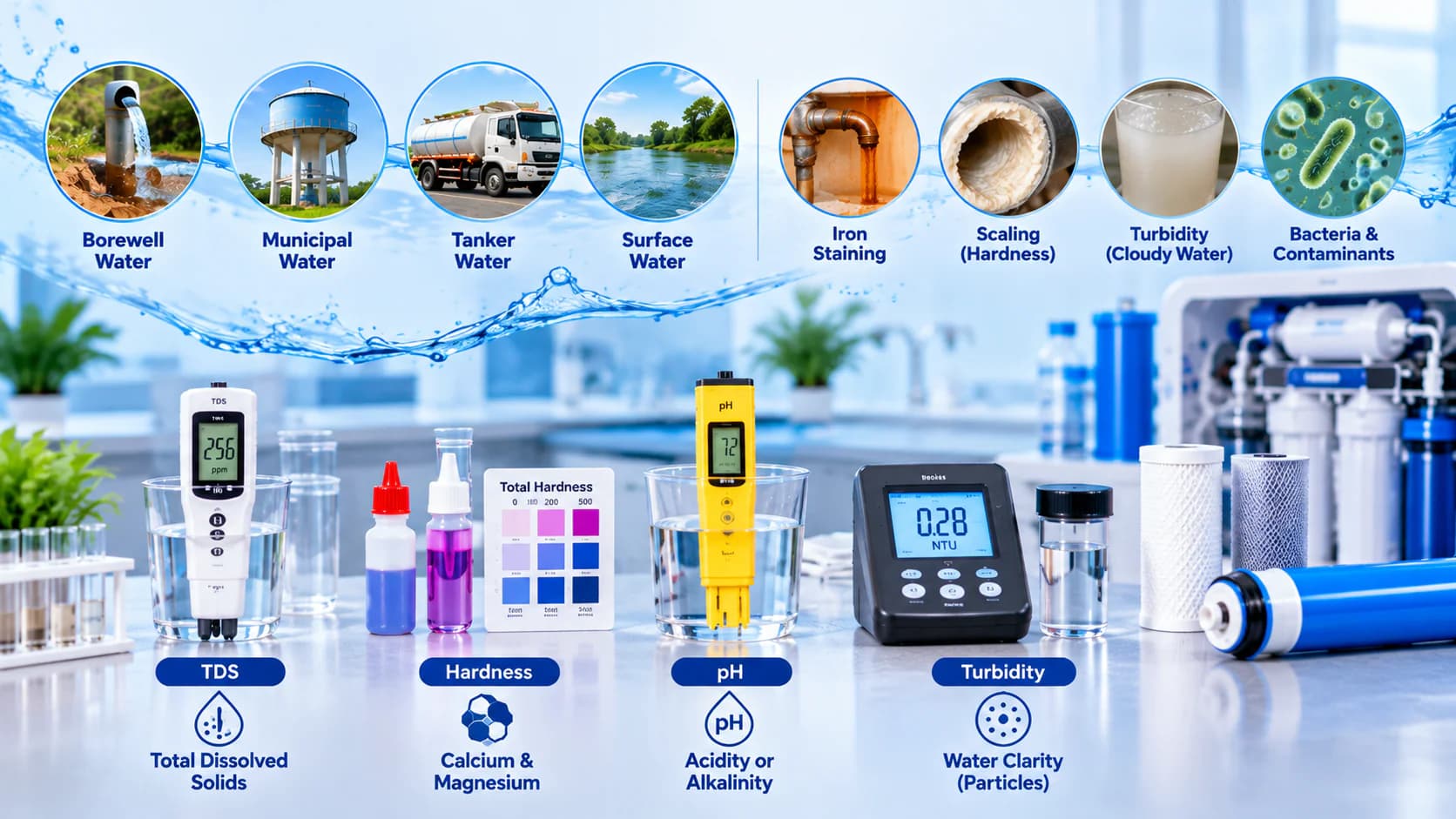
Start from your source water. Use RO when TDS or dissolved contaminants are high, and UV and/or UF with carbon when TDS is already acceptable and the main concern is microbial safety.
| Your water | Typical concern | Usually suitable |
|---|---|---|
| Treated municipal supply, TDS below about 300 mg/L | Microbial contamination in pipes or tanks; chlorine taste | Carbon + UV and/or UF |
| Mixed supply / tanker, TDS 300–500 mg/L | Microbes; variable quality | Carbon + UV/UF; RO only if a test shows dissolved contaminants |
| Borewell, TDS above 500 mg/L | Dissolved salts, hardness, possibly fluoride or nitrate | RO + UV/UF, with a higher-recovery RO where possible |
| Known fluoride, arsenic or nitrate issue | Specific dissolved contaminants | RO (verify with a post-treatment test) |
Why do many purifiers combine RO, UV and UF?
Because they complement each other. RO handles dissolved contaminants, while UV and/or UF provide an independent microbial barrier after the membrane or storage tank. This follows the multi-barrier principle used in drinking-water safety.[4]