
UV disinfection is used everywhere from household purifiers to large municipal treatment plants. It is fast, chemical-free and highly effective against microbes, provided the water and the equipment meet a few conditions.
What is UV water disinfection?
UV disinfection is a physical process that uses germicidal ultraviolet light in the UV-C band (about 200–280 nm) to inactivate microorganisms in water as it flows past a lamp enclosed in a quartz sleeve.[1][2]
How does UV kill bacteria and viruses?
Nucleic acids absorb UV-C strongly, with a peak near 260 nm. The absorbed energy forms bonds between adjacent bases (mainly thymine dimers in DNA), so the organism cannot copy its genetic material or multiply. An organism that cannot reproduce cannot cause infection.[1][3]
- UV dose (fluence)
- Intensity × exposure time, in mJ/cm². It determines how many microbes are inactivated.
- UV transmittance (UVT)
- The percentage of UV light that passes through the water. Turbidity, colour, iron and organics lower it.
- Log inactivation
- 4-log = 99.99% of organisms inactivated.
- Photoreactivation
- Some bacteria can repair UV damage under visible light when the dose was too low, which is one reason doses include a safety margin.
What affects UV performance?
| Factor | Effect | What to do |
|---|---|---|
| Turbidity / particles | Shields microbes from light | Filter first (sediment, UF, RO) |
| Iron, manganese, hardness | Coat the quartz sleeve and absorb UV | Pre-treat; clean the sleeve |
| Lamp age | Output declines over time even while still glowing | Replace about yearly or per manufacturer |
| Flow rate | Higher flow means less exposure time | Stay within the rated flow |
| Power cuts | No disinfection while off | Store treated water hygienically; consider UF backup |
UV vs chlorine: which is better?
They serve different roles. UV is excellent at the point of use and is more effective against chlorine-resistant protozoa such as Cryptosporidium, but it leaves no residual. Chlorine provides residual protection through pipes and tanks but can form by-products and affect taste.[1][2]
| UV | Chlorine | |
|---|---|---|
| Adds chemicals | No | Yes |
| Residual protection | No | Yes |
| Cryptosporidium / Giardia | Highly effective | Cryptosporidium resistant |
| Taste / odour | No change | Chlorine taste possible |
| By-products | None of significance at drinking-water doses | Can form disinfection by-products |
| Depends on clarity | Yes | Less so, but turbidity still reduces effect |
Is a UV-only purifier enough?
Only when the water's chemistry is already acceptable: low TDS, no fluoride, arsenic or nitrate problems, and clear water. That is typical of well-treated municipal supply. UV does not change TDS or remove chemicals, so high-TDS or chemically contaminated water needs RO.
UV strengths
- Fast, chemical-free disinfection
- No change to taste, pH or minerals
- No waste water; low power
- Effective against chlorine-resistant protozoa
UV limitations
- Removes nothing; dead cells remain in the water
- Needs clear water and continuous power
- No residual protection in storage
- Lamp output declines and is invisible to users
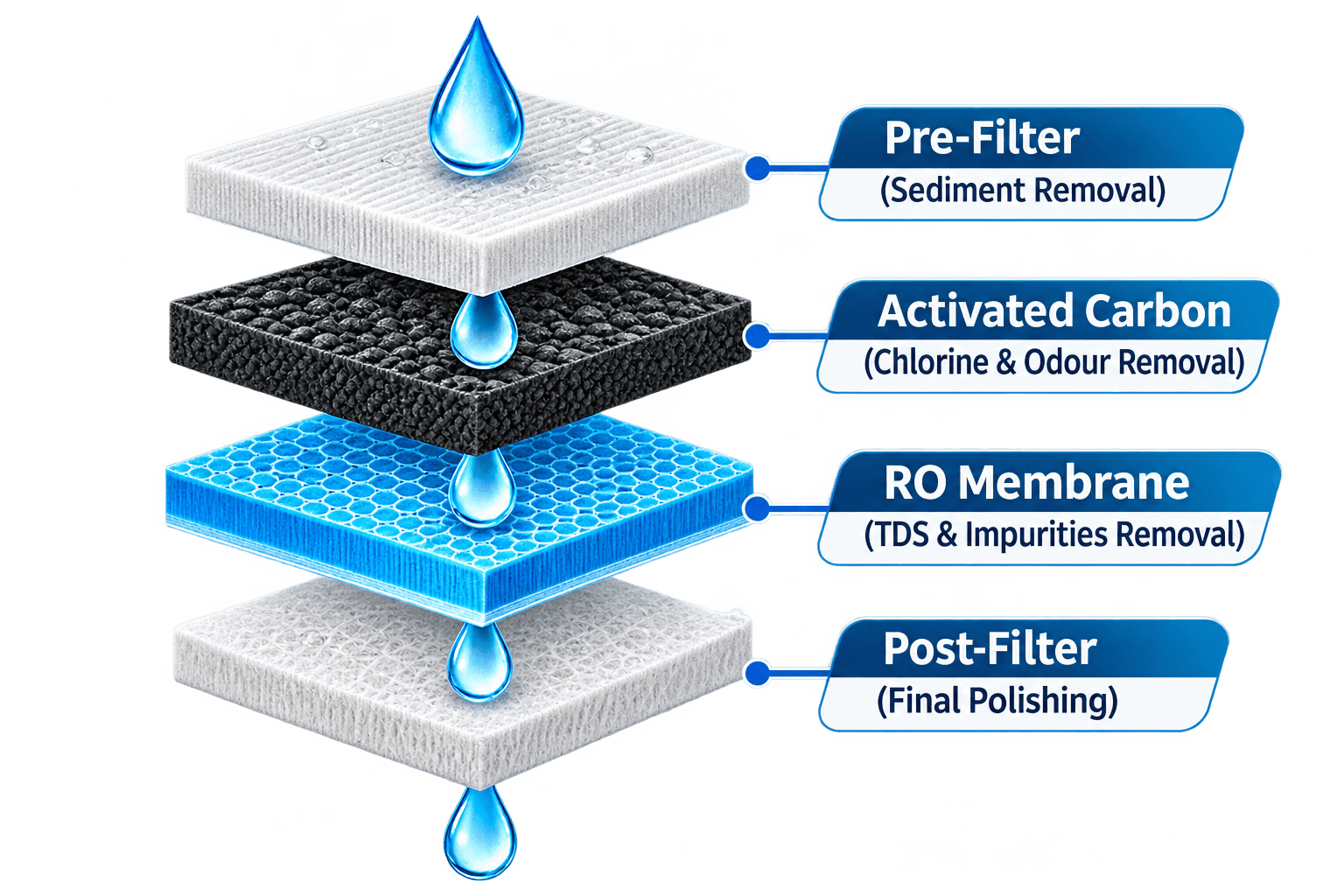
In combined purifiers, UV is placed after RO or after the storage tank as an independent microbial barrier. See Stages of Water Purification.