
Which Alkaline Water Purifier Is Best for Everyday Drinking?
Drinking water is something we depend on every day. From preparing tea and coffee to filling water bottles for work and school, access to suitable drinking water is essential for every household.
With several water purification technologies available today, choosing the right purifier can become confusing.
RO, UV, UF, copper filtration and alkaline mineralisation are some of the features commonly advertised in modern water purifiers.
But which alkaline water purifier is best for everyday drinking?
The answer depends on your water source, household consumption, water quality and the purification features your home actually needs.
In this guide, we compare the important technologies and explain how to choose a suitable alkaline water purifier.
What Makes an Alkaline Water Purifier Different?
A conventional water purifier focuses on treating water to reduce specific impurities and contaminants.
An alkaline water purifier combines purification with an additional mineralisation process designed to increase the pH of the treated water.
Depending on its configuration, the system may include:
Sediment filtration.
Activated carbon filtration.
Reverse osmosis.
Ultraviolet treatment.
Ultrafiltration.
Alkaline mineral cartridges.
Post-carbon filtration.
The exact combination varies by manufacturer and model.
Understanding Different Water Purification Technologies
1. Reverse Osmosis (RO)
RO uses a semi-permeable membrane to reduce dissolved salts and other impurities.
It is particularly relevant for certain high-TDS water sources.
However, its use should be determined by water quality testing rather than marketing claims.
2. Ultraviolet (UV) Purification
UV systems use ultraviolet light to inactivate susceptible microorganisms.
UV does not remove dissolved salts and is generally used alongside other treatment technologies.
3. Ultrafiltration (UF)
UF uses a membrane to separate certain suspended particles and microorganisms.
It does not normally reduce dissolved salts in the same way as RO.
4. Activated Carbon Filtration
Activated carbon helps reduce chlorine, certain organic compounds and unpleasant tastes or odours, depending on the cartridge design.
5. Alkaline Mineralisation
An alkaline mineral cartridge adds selected minerals and changes the pH of treated water.
It is important to distinguish mineralisation from contaminant removal. The alkaline stage should not be treated as a replacement for appropriate primary purification.
Comparison of Alkaline Water Purifier Features
Technology | Main Function | What to Consider |
|---|---|---|
RO | Reduces dissolved salts and selected contaminants | Incoming TDS and water composition |
UV | Inactivates susceptible microorganisms | Power supply and maintenance |
UF | Physical filtration barrier | Particle and microbial specifications |
Activated Carbon | Reduces certain chemicals and odours | Carbon quality and replacement |
Alkaline Cartridge | Adjusts pH and adds minerals | Output pH and cartridge lifespan |
Post Carbon | Final taste conditioning | Cartridge maintenance |
Which Type of Alkaline Water Purifier Should You Choose?
For Homes Using Borewell Water
Borewell water can have varying levels of dissolved salts, hardness and other contaminants.
An RO-based system may be appropriate when testing identifies contaminants that RO is designed to reduce.
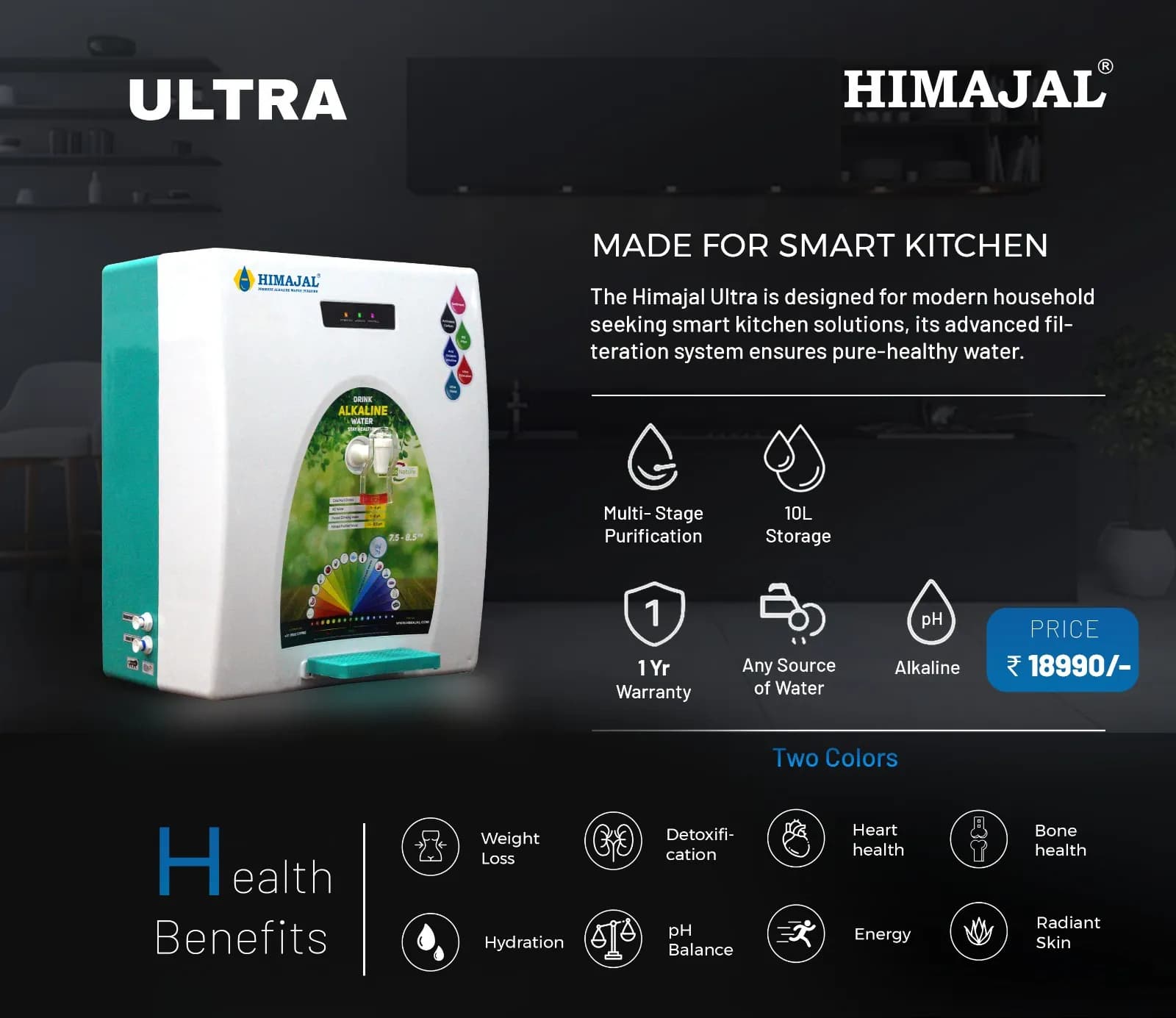
Himajal Ultra is one product option featuring RO, UV, UF and alkaline filtration.
Explore Himajal Ultra.
For Families Looking for Multiple Purification Features
Households that want several filtration and mineralisation technologies can consider multi-stage systems.
Himajal Galaxy combines RO, alkaline mineralisation, copper, zinc and UV technology.
Explore Himajal Galaxy.
For Households Looking for Added Convenience
Some households prefer appliances that offer more than drinking water purification.
Himajal Smart X combines alkaline RO purification with hot-water dispensing and an integrated ozonator.
Explore Himajal Smart X.
6 Questions to Ask Before Purchasing
Before selecting a purifier, ask:
What is the TDS level of my incoming water?
Does my water source require RO treatment?
Does the purifier include the filtration stages I need?
What is the actual alkaline output pH?
How much will filter replacement and maintenance cost?
Is installation and after-sales support available in my area?
These questions will help you avoid purchasing unnecessary features.
Why Consider Himajal for Everyday Water Purification?
Himajal offers multiple residential water purification configurations.
Its product range includes RO-based alkaline purifiers, multi-stage filtration systems and models with additional convenience features.
When evaluating Himajal, compare individual product specifications and choose according to your source water and household requirements.
The company also advertises free installation and customer support for its residential purifier range, subject to applicable terms and location availability.
Conclusion – Choose Based on Water Quality, Not Just Features
There is no single purifier that is automatically best for every household.
A suitable alkaline water purifier should match your source water, filtration requirements, family size, budget and maintenance expectations.
Get your water tested, compare product specifications and choose a system designed for your actual requirements.
Himajal brings together multiple water purification technologies to help households explore suitable drinking water solutions.
CTA: Find the Right Himajal Water Purifier for Your Home.
Frequently Asked Questions
1. Which alkaline water purifier is best for everyday drinking?
The best choice depends on your water source, contaminants, household consumption and the purifier's specifications.
2. Is RO plus alkaline better than a normal RO purifier?
An RO plus alkaline system includes an additional mineralisation stage that adjusts water pH. Whether this additional feature is necessary depends on your requirements.
3. Does an alkaline purifier remove bacteria?
This depends on the purification technologies included. RO, UV and UF have different treatment functions. Check the model's verified performance specifications.
4. Can alkaline water purifiers handle high-TDS water?
Certain RO-based alkaline purifiers are designed for high-TDS water. Check the permitted operating range for the particular model.
5. What is the difference between RO and alkaline filtration?
RO reduces dissolved impurities through membrane filtration. Alkaline filtration generally adds selected minerals and adjusts the water's pH.
6. How do I know which purifier is suitable for my home?
Start with a water quality test. Then consider the source, TDS, contaminants, household consumption and maintenance requirements.
7. Are alkaline water purifiers expensive to maintain?
Maintenance expenses vary according to the number of filters, RO membrane replacement, usage and service requirements. Ask for an estimated annual maintenance cost before purchasing.